
If you’re struggling long after a traumatic event, you may notice memories that intrude, situations you steer around, and beliefs about blame or safety that won’t let go. When these patterns persist, trauma-focused psychotherapy is a first-line option. Two of the most studied methods are Cognitive Processing Therapy (CPT) and Prolonged Exposure (PE) . Our therapists at MindSpa Psychiatry are trained in both CPT and PE. We deliver online therapy across Florida via secure video.
In this article, we will compare, how the two methods work, how a clinician helps decide between them, and what online trauma-focused therapy for PTSD looks like from your living room.
Why CPT and PE Come Up First
The Department of Veterans Affairs and Defense (VA/DoD) Clinical Practice Guideline (CPG) for posttraumatic stress disorder (PTSD) and acute stress disorder (ASD), recommends individual, manualized trauma-focused psychotherapies for PTSD. CPT, PE, and EMDR are named among the recommended options. The same guideline recommends secure video for trauma-focused therapies shown to work via video.
It also encourages shared decision-making. In plain terms, the guideline does not rank one method as the winner for everyone. It asks clinicians and patients to choose together. For online trauma-focused therapy for PTSD, these two methods are common starting points for that conversation.
How CPT Works: Working Through Trauma-Related Beliefs
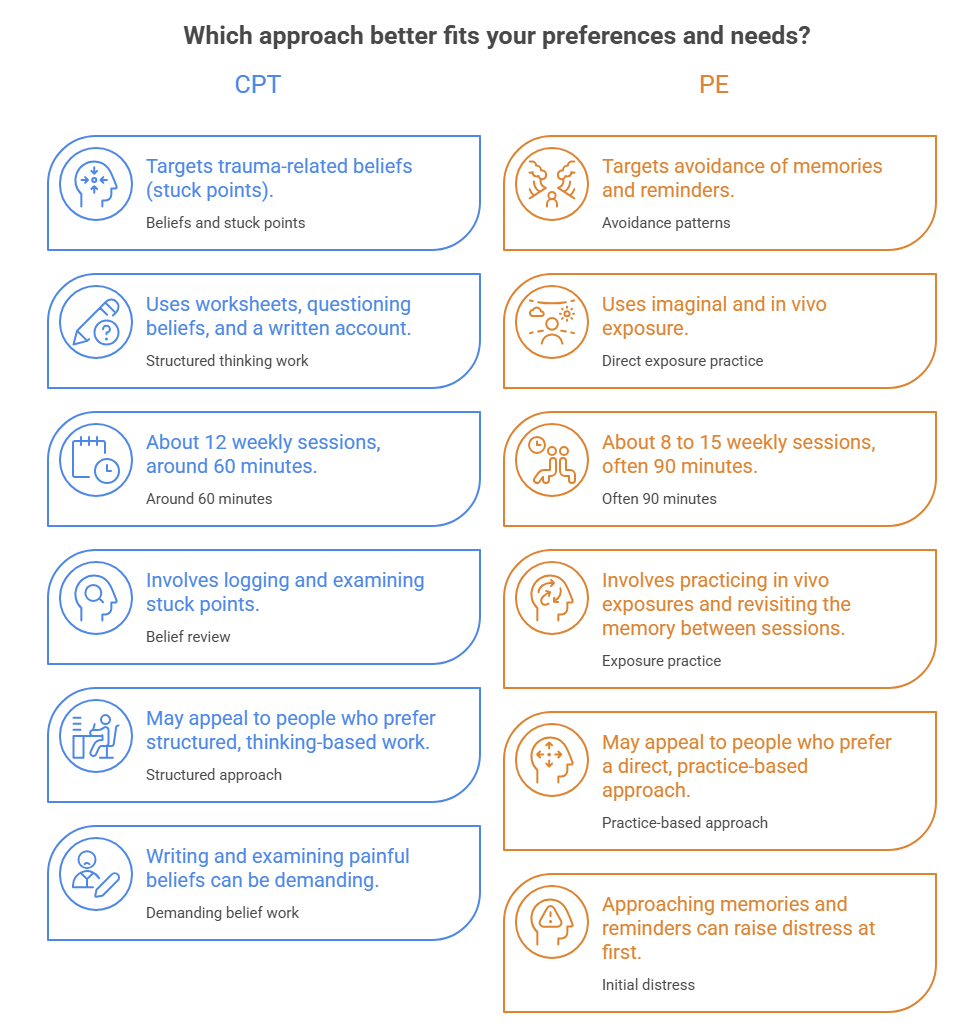
CPT focuses on the conclusions a person draws after a traumatic event. These are often called "stuck points," meaning beliefs that keep an individual in distress. Common examples include "It was my fault" or "I can't trust anyone." They are often why trauma can leave you feeling like a different person.
A typical CPT course runs about 12 weekly sessions of roughly 60 minutes. Here is what the work usually involves:
- Identifying stuck points together with your therapist
- Using worksheets to examine whether each belief fits the facts
- Sometimes by writing an account of the event and reviewing how it shaped your thinking
- Practicing between sessions, often by logging stuck points and questioning them
CPT is structured and thinking-oriented. It asks you to look at the event, but the main emphasis is on how you make sense of it.
How PE Works: Gradually Approaching Memories and Reminders
PE targets avoidance. After trauma, people often steer clear of memories, places, and activities that feel distressing, even when those reminders are not harmful today. Avoidance can bring short-term relief while keeping the problem alive.
PE uses two kinds of exposure:
- Imaginal exposure: Revisiting the trauma memory aloud, in detail, in a controlled setting, followed by time to talk through the experience
- In vivo exposure: Gradually approaching safe but avoided situations in real life, working up a ranked list from least to most distressing
A standard PE course runs about 8 to 15 weekly sessions, traditionally 90 minutes each. Some clinics use 60-minute sessions with shorter imaginal exposure, although research on that format is still limited.
PE is built on repetition. At MindSpa Psychiatry & Therapy, we understand that facing trauma-related reminders can feel difficult. Prolonged exposure therapy uses repeated, guided practice to help people gradually feel less distressed by these reminders and build confidence in managing their responses at a pace that feels comfortable.
CPT vs. PE at a Glance
What the Research Says Without Overpromising
The largest head-to-head trial compared PE and CPT in 916 veterans across 17 VA medical centers. PE produced somewhat larger reductions in PTSD symptoms, but the difference did not reach the study's threshold for clinical significance. Both groups showed meaningful improvement, and the authors noted that patient preference should be considered. Neither method is guaranteed to work for every person, and neither is automatically the right first pick. Your history, symptoms, preferences, and circumstances matter.
How Clinicians Decide Which Approach May Fit
Matching a method to a person starts with a clinical assessment. A provider typically reviews:
- Your symptoms and history: What you experience, how long it has lasted, and how it affects sleep, work, and relationships
- Standardized screening: Validated questionnaires, such as the PTSD Checklist, help measure severity and track progress
- Other concerns: Depression, anxiety, insomnia, or substance use can shape the treatment plan
- Safety: Any thoughts of self-harm and your current support system
- Readiness and stability: Whether your daily life leaves room for weekly sessions and between-session practice
Then comes the conversation about fit. Clinicians commonly weigh questions such as:
- Is avoidance the biggest obstacle, or are guilt, shame, and self-blame at the center?
- Would you rather work through worksheets and written exercises, or practice facing reminders directly?
- Can you commit to 60-minute or 90-minute sessions?
- Have you tried trauma therapy before, and what did you notice?
- Which methods does your therapist have training in?
At MindSpa Psychiatry & Therapy, serving Miami, Boca Raton, West Palm Beach, and Boynton Beach, we understand that every person's needs are different. Our clinicians regularly review progress and adjust treatment plans when needed to ensure the approach continues to support each individual's recovery and well-being.
What Remote Sessions Involve
Online trauma-focused therapy for PTSD uses a secure, encrypted video platform. You join from a private space with a steady connection and, ideally, headphones.
Here is what to expect:
- Setting up: Clinicians typically confirm where you are at the start of care and agree on a plan for what to do if distress spikes or safety becomes a concern.
- CPT online: Worksheets and written assignments can be shared digitally, and session time is spent examining beliefs together.
- PE online: Imaginal exposure takes place during the session, with time afterward to process it. In vivo exercises happen in your everyday environment, which suits remote care well.
- Pacing: Your clinician guides how quickly you move, and you can talk through distress as it comes up.
In other words, remote delivery appears comparable. If you do not have a private space or are facing a safety risk, a clinician may recommend in-person therapy.
Before Your First Visit
Some steps can help while you arrange care:
- Write down situations, places, or reminders you avoid
- Jot down recurring thoughts about the event, especially ones involving blame or safety
- Track sleep, mood, and triggers for a week or two
- Set up a private, comfortable space for video sessions
- Tell a trusted person that you are seeking help
These steps build awareness and make your first appointment more productive. They are not a replacement for treatment.
Avoid forcing yourself through intense exposure alone. The structure, pacing, and processing in CPT and PE are what make them tolerable and effective, and a trained clinician adjusts them in real time.
Where a Clinician Comes In for Online Trauma-Focused Therapy for PTSD
Diagnostic & Safety Screening: A comprehensive clinical assessment including suicide and safety screening and a written safety plan to ensure remote or home-based trauma work is safe for you.
Structured Evidence-Based Therapies: Delivers clinical modalities like Trauma-Focused CBT (TF-CBT), Eye Movement Desensitization and Reprocessing (EMDR), or Cognitive Processing Therapy (CPT) adapted for secure video platforms.
Pacing and Exposure Guidance: Controls the pace of deep trauma processing so you do not dive into overwhelming memories alone.
Bilateral Interventions: Guides virtual EMDR (such as tracking on-screen hand movements for bilateral stimulation) and helps integrate body-based or somatic healing safely.
Medical Support & Crisis Planning: Collaborate with practitioners at MindSpa Psychiatry & Therapy for targeted therapy and build a formal safety plan.
How Care Starts at MindSpa Psychiatry & Therapy
MindSpa Psychiatry and Therapy provides adult psychiatry and therapy, including online trauma-focused therapy for PTSD. We deliver through secure video visits across Florida, including patients in Miami, Boca Raton, West Palm Beach, Boynton Beach, Delray Beach, Lake Worth, Royal Palm Beach, and Wellington. The practice includes board-certified psychiatric providers and licensed therapists, several of whom list trauma and PTSD among their focus areas.
Getting started takes four steps:
- Complete a short intake form, which takes under five minutes.
- Speak with the intake team, who gather details and schedule your appointment.
- Confirm your appointment during a quick follow-up call.
- Meet your licensed provider by private, encrypted video.
Your first visit is an evaluation. Your provider reviews your symptoms and history, discusses trauma-focused therapy options, and builds a personalized plan with you. Which specific method is offered depends on the clinician, so ask about it when you call. Some people also discuss medication alongside therapy. Contact us at MindSpa for prescription information.
Insurance questions are common, so took a step forward and partnered with insecure companies such as Aetna, Cigna, United Healthcare, Blue Cross Blue Shield, Tricare, Oxford and Oscar
Take the Next Step
If trauma symptoms are interfering with your sleep, work, or relationships, you do not have to sort out CPT, PE, and everything else alone. Call MindSpa Psychiatry and Therapy at 561-576-9404 or request an appointment online to explore online trauma-focused therapy for PTSD with a licensed provider, starting with an evaluation.
Note: This article is for general education and is not a substitute for professional medical advice, diagnosis or treatment.
References
- The Management of Posttraumatic Stress Disorder and Acute Stress Disorder: Synopsis of the 2023 VA/DoD Clinical Practice Guideline -> https://pubmed.ncbi.nlm.nih.gov/38408360/
- VA/DoD Clinical Practice Guideline for PTSD and Acute Stress Disorder: Clinician Summary -> https://psychiatryonline.org/doi/10.1176/appi.focus.16408
- Using the 2023 VA/DoD Clinical Practice Guideline for PTSD and Acute Stress Disorder, ISTSS -> https://istss.org/?p=2850
- Comparison of Prolonged Exposure vs Cognitive Processing Therapy for PTSD Among US Veterans, JAMA Network Open, 2022 -> https://pmc.ncbi.nlm.nih.gov/articles/PMC8771295
- Comparing Dropout From Cognitive Processing Therapy Versus Prolonged Exposure: Results From a Randomized Clinical Trial -> https://www.centreforevidence.org/article/20260301-comparing-dropout-from-cognitive-processing-therapy-versus-prolonged-exposure-results-from-a-randomized-clinical-trial
- US Medicine, coverage of the PE vs CPT comparison trial -> https://www.usmedicine.com/?p=17164
- A Non-Inferiority Trial of Prolonged Exposure for PTSD: In Person versus Home-Based Telehealth -> https://pmc.ncbi.nlm.nih.gov/articles/PMC5222772
- In-office, In-home, and Telehealth Cognitive Processing Therapy for PTSD in Veterans: A Randomized Clinical Trial -> https://pmc.ncbi.nlm.nih.gov/articles/PMC8763446
- ClinicalTrials.gov, Comparative Effectiveness Research in Veterans With PTSD (protocol descriptions of CPT and PE) -> https://clinicaltrials.gov/study/NCT01928732
- VA PTSD Care, descriptions of CPT and PE session length -> https://www.va.gov/north-florida-health-care/programs/ptsd-care/
- Center for Deployment Psychology, 60-Minute Prolonged Exposure Sessions -> https://deploymentpsych.org/sites/default/files/member_resource/COP_Toolkit/60_Min_PE_Sesssions.pdf