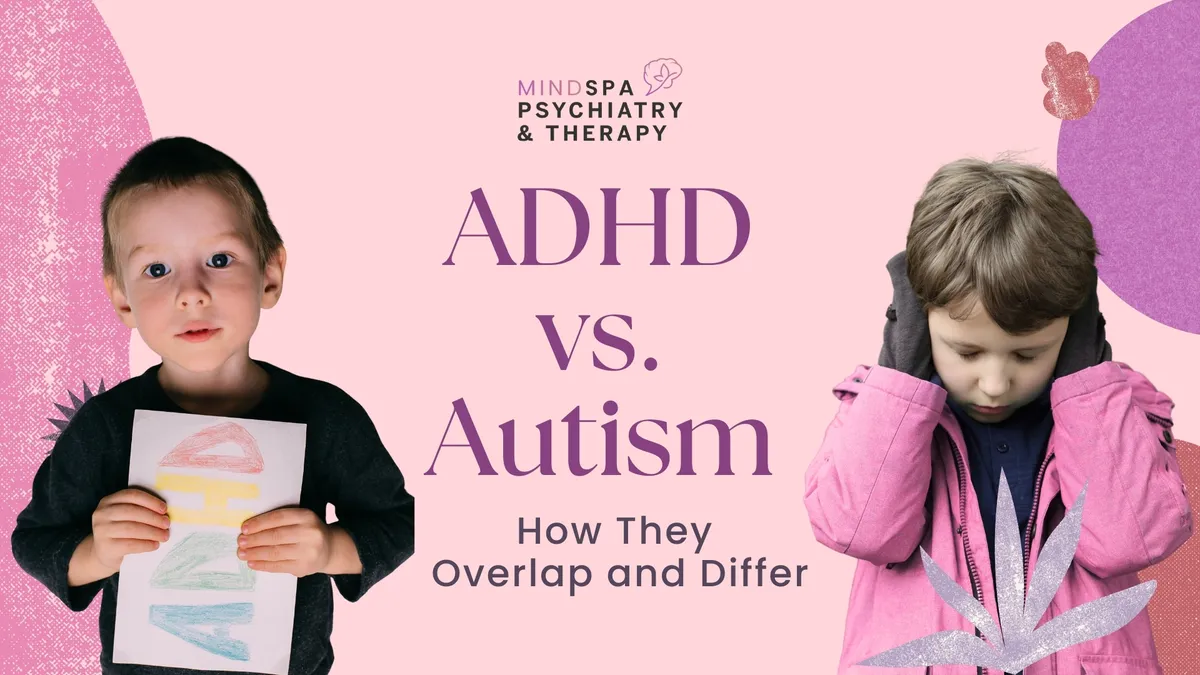
ADHD and autism are different neurodevelopmental disorders. They affect the brain. They influence behavior, concentration, emotionality, and social life. Many people confuse the two. Some assume they are the same. Some believe that there is only one. But that is not true. It can be ADHD or autism, or both. And they may be quite different from each other.
Understanding both conditions clearly removes confusion. It is also useful in early diagnosis, proper treatment, and improved mental health.
What is ADHD?
Attention Deficit Hyperactivity Disorder influences concentration and attention. It may also include hyperactivity. ADHD shows up in childhood. It often continues into adulthood.
Common signs of ADHD include –
- Difficulty in concentrating on a single activity or task
- Forgetting things often
- Being easily distracted
- Unplanned choices or behaviors
- Difficulty sitting still
- Interrupting conversations
- High levels of tediousness
- Poor time management
The brains with ADHD require stimulation. Without it, the mind wanders. This causes restlessness. It may also touch school, work, and relationships.
What is Autism?
Autism or Autism Spectrum Disorder (ASD) is a condition that alters the manner in which a person communicates, behaves, and perceives the world. It is a spectrum. It means that the symptoms and competencies differ in every case.
Some of the common characteristics of autism are:
- Difficulty understanding social signals
- Trouble making eye contact
- Routine or regular activities
- Hypersensitivity of the auditory, visual, touch, or tactile sensation
- Great attention to particular issues
- Preferring structure and predictability
- Difficulty adjusting to changes
Autism is not a learning disability. Many autistic individuals are highly intelligent. They just process the world differently.
The Core Differences Explained Simply
The primary distinction between ADHD and autism is the cause of the behaviors. An individual with ADHD would want a consistent stimulation or excitement, or a change. Even when doing something that they had enjoyed, they might get bored soon and lose interest easily.
Instead, the autistic person will seek to attain stability, predictability, and order. They are not aware of how these things may be lacking in their lives, and they desire things to be just like they are accustomed to. They can stick to interests over an extended period, and they can get along with routine. Autism brains may also not like too much stimulation, as their brains may find it overwhelming, unlike normal ADHD brains that need more stimulation.
Social Communication Differences
Both ADHD and autism may influence communication, although not in the same manner. An individual with ADHD can talk all at once, interrupt someone without even noticing, or jump to another subject of conversation. They can have difficulties when waiting to be heard or when observing crucial things when speaking or listening.
An autistic individual might be guarded or literal in his or her communication. They might not be able to read tone, sarcasm, or some social cues. Human beings hate gossiping and prefer serious discussions. Their brains are also capable of processing a language more slowly, which implies that they may take a longer time to respond.
Attention and Focus: Difference Between Them
The difference in attention between ADHD and autism is of a different nature. ADHD Attention is scattered. One can begin numerous tasks simultaneously and finish a few. They are distracted by noises, ideas, or novel thoughts. But once it is something appealing, they will be able to hyperfocus and spend hours.
Captive concentration is autistic. They can think keenly about things that they like. But it is very difficult to cease paying attention to it. They would not be easily distracted by things around them when they are fully engaged. In such a way, the attention of ADHD is too rapid, and that of autism is profound and more lengthy.
Affective Sensitivity and Control
Both conditions are characterized by emotional issues. The emotions associated with ADHD might be abrupt and sharp. Minimal annoyances can cause intense responses. They are easily irritated in their mood, particularly when idleness, congestion, or interruption occurs.
The emotions experienced by autistic people are profound as well, although they are triggered in different ways. In case of excess noise, change, confusion, or overload of sensations, meltdowns may occur. Most autistic people feel deeply, but they may not convey this in a particular way, or they may just need time to process these feelings.
Challenges in Everyday Life in Both
Autism and ADHD affect executive functioning. This has an influence on planning, organizing, beginning, and time management.
Examples include:
- Difficult with work or school activities
- Problem with cleaning or clearing personal areas
- Losing memory of appointments or significant information
- Losing track of time
- Being engulfed by daily duties.
Distraction, boredom, or impulsivity would typically be challenging in ADHD. In autism, it is usually precipitated by the need for structure, predictability, or clarity.
Conclusion
ADHD and autism are not the same, but may be combined. Most individuals have been silently going through years of difficulty without knowing why it seems hard to focus, feel confused when making social interactions, or have overwhelming emotions. The correct diagnosis does not identify an individual. It gives them clarity. It assists them in getting out of self-blaming. It clears the way for the appropriate support, strategies, and self-acceptance.
Take the Next Step With MindSpa Psychiatry & Therapy
You deserve answers. You deserve support. You should know what is going on in your mind without being judged. Professional assessment, compassionate care, and the TOVA are provided during the Boynton Beach location of MindSpa.
FAQs
What are the overlaps between ADHD and autism?
Both of them involve attention difficulties, emotional instability, and interpersonal conflicts. Numerous individuals are both simultaneously.
Do I have autism or ADHD?
A professional assessment can only prove it. The symptoms may exhibit similarity, and hence the testing will aid in distinguishing or identifying both.
Could it happen that ADHD, anxiety, and autism overlap?
Yes. The anxiety is characteristic of ADHD and autism. It usually results in sensory overload, social difficulties, or executive dysfunction.
What is the rate of overlap of autism and ADHD?
Studies show 30–50% of autistic individuals also have ADHD traits. Many get a dual diagnosis.
What is 90% of autism caused by?
No single cause exists, but the most significant is the genes. Brain development and environment may also influence it.